Let me give you the short answer first. You get cited by posting something only you can say: a story from your own work, a number nobody else has, or an opinion you can defend. Clean formatting helps, but it's the bare minimum, not the reason a post gets picked.
Now, I know that answer raises a few doubts. So let me take them one at a time, the way I would if you were sitting across from me.
Yes, and a lot more than it did a year ago. Profound data reported by Axios in March 2026 showed LinkedIn's citation frequency in AI answers roughly doubled between November 2025 and early 2026, making it the most cited domain for professional questions. Semrush studied 89,000 LinkedIn URLs cited across 325,000 prompts and found LinkedIn shows up in about 11% of AI responses: 14.3% of answers on ChatGPT Search, 13.5% on Google AI Mode and 5.3% on Perplexity.
So when a buyer asks an AI tool who to trust in your space, LinkedIn is part of what it reads. Your posts are already in the room.
Useful, original ones. In the Semrush data, about 95% of cited posts were original rather than reshares, and between 54% and 64% shared knowledge or practical advice. Cited posts most often ran 50 to 299 words. LinkedIn articles made up 50% to 66% of the cited content and usually ran 500 to 2,000 words.
So if you've been thinking you need long, clever essays every week, you don't. A short post with one clear answer can be quoted. An article just gives the AI more to work with.
No, and this is the part I love telling founders. In the same study, accounts with fewer than 500 followers were cited as often as bigger ones, sometimes more. The median cited post had just 15 to 25 reactions and no more than one comment.
So stop measuring yourself against the people who go viral. A quiet post with a sharp, honest answer can do more for you than a loud one.
You don't need daily posting. About 75% of cited authors posted five or more times in a four week stretch, which is a little over one post a week. That matches what I tell founders: one or two strong posts a week beats four thin ones. Consistency matters more than volume.
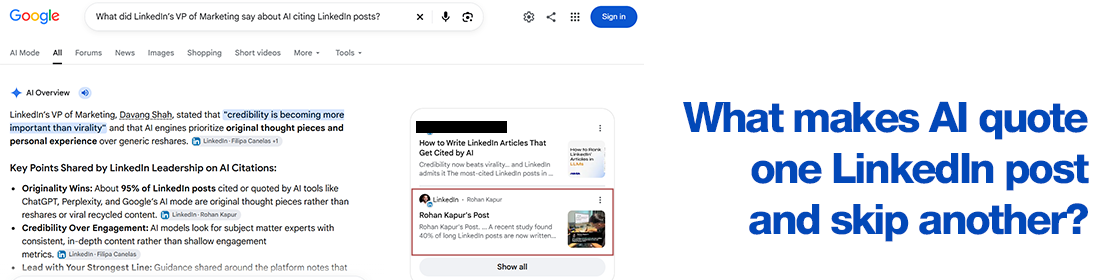
You'll see a lot of advice saying exactly that. But LinkedIn's own VP of Marketing, Davang Shah, wrote in September 2026 that formatting your content so AI can read it is "the entry fee". His point is that AI tools skip generic information and cite sources with something new: original data, first hand experience, or a framework that has been tested. He also says models gain confidence when the same idea appears in several credible places, so repeating your view in posts, interviews and articles helps.
I want to be straight with you about two things. LinkedIn sells advertising, so it has its own reasons to say this. And his post doesn't prove that a point of view causes citations. The Semrush data shows what cited posts have in common, not what makes them get picked. Treat all of it as strong direction, not a guarantee.
I mean something someone who wasn't in the room couldn't write. It usually comes from one of four places:
1. Your numbers. What happened when you changed your pricing, your hiring process or your sales call.
2. Your mistakes. The decision you got wrong and what it cost you.
3. Your conversations. The question customers keep asking that nobody answers well.
4. Your disagreements. The popular advice in your field that you've quietly stopped following, and why.
If you're thinking "I don't have anything like that", you do. You just haven't been asked the right questions yet.
Run a ten minute test. Open ChatGPT, Perplexity and Gemini. Ask each one the same five questions a buyer in your market would ask, such as "who should I trust for advice on X?" or "what's the best way to do Y?" Write down who gets named, which LinkedIn posts show up, and what wording comes back. Do it once a month. You'll quickly see which of your ideas are travelling and which are invisible.
Pick one question your buyers ask AI tools and write the best, most specific answer you can, with a real example from your own work. Put the direct answer in the first two lines. Then say the same idea somewhere else within a month, maybe as a short post and then an article. Most founders I talk to already hold the stories that would get cited. What they don't have is the time to dig them out and shape them, and if that sounds like you, book a discovery call and we'll work out together what's worth saying.